
Scaling Challenges: Why Growth Breaks Operations First
The biggest scaling challenges for a small or mid-sized business are rarely about demand. They are about how the business makes and keeps money once volume rises: processes that depended on a few people, cash that arrives later than costs, and tools that were added one at a time and never fitted together. The fix is to map how revenue actually moves through the company, find where it leaks, and repair those points before adding people, locations or software. That is how we work at Raremind: we start with how you make money, not with technology.
RaremindFind What’s Holding Growth BackRaremind’s Money Map identifies lost revenue, excessive costs, and process inefficiencies, without pushing unnecessary technology.Visit
TL;DR
Scaling means revenue grows faster than the resources needed to produce it. Growing with costs rising at the same pace is not scaling.
The most common breakpoints are processes that live in people’s heads, cash tied up in growth, disconnected tools, and an owner who becomes the bottleneck.
In the 2026 Inc. 5000 CEO Survey, about half of fast-growing CEOs named balancing strategy with daily operations and standardizing processes as scaling challenges.
Fix the revenue path first (where money is lost, delayed or spent twice), then standardize, then automate, then add capacity.
An independent review that sells no software keeps the focus on the problem instead of on a tool.
Table of Contents
What scaling really asks of a business
The scaling challenges that show up most often
A quick diagnostic: where is your business breaking?
A sequence that avoids adding complexity
Why an independent view helps
Our perspective
How Raremind supports a scaling business
Sources
What scaling really asks of a business
People use “growing” and “scaling” as if they were the same. They are not. Management research defines scaling as an increase in size accompanied by a larger-than-proportional increase in performance, while growth is an increase in one indicator taken alone. In plain terms: if you double revenue and double headcount, rent, software and overtime, you grew. If you double revenue and costs rise far less, you scaled.
That difference is why scaling problems feel so sudden. A company can add customers for years on goodwill and hard work. At some point the extra volume lands on a process that was never designed for it, and every new sale costs more effort than the last one.
The scaling challenges that show up most often
The lists you find online run long, but the same few problems sit underneath most of them. Here is what the evidence says.
Processes that live in people’s heads
Small teams are fast because people sit close to the work and fill gaps informally. Those habits stop working when the team doubles. Nobody wrote down how a quote is approved, how an order is handed to delivery, or how a refund is decided, so each person does it a little differently.
This shows up in survey data. In the 2026 Inc. 5000 CEO Survey, 48% of respondents cited standardizing business processes across departments or locations as a challenge of scaling operations, and 51% cited balancing strategic planning with day-to-day operations.
The symptoms are easy to recognize: rework, inconsistent customer experience, new hires who take months to become useful, and managers who spend their days answering questions that a one-page procedure would settle. Our guide on process standardization for small businesses walks through how to do this without burying the team in paperwork.
Growing faster than your capabilities
In a Harvard Business Review article, Gary Pisano explains the idea of a sustainable growth rate: the fastest a company can grow without selling equity or borrowing. His warning is that leaders apply this discipline to money but not to staffing, management capability and operating processes, so “growing pains” harden into permanent problems.
He also describes a vicious circle. Capability shortfalls cause quality and operating problems. Those problems drain stretched resources. The company reacts with stopgap hiring and infrastructure spending and ends up with patchwork systems, an exhausted workforce and a damaged reputation.
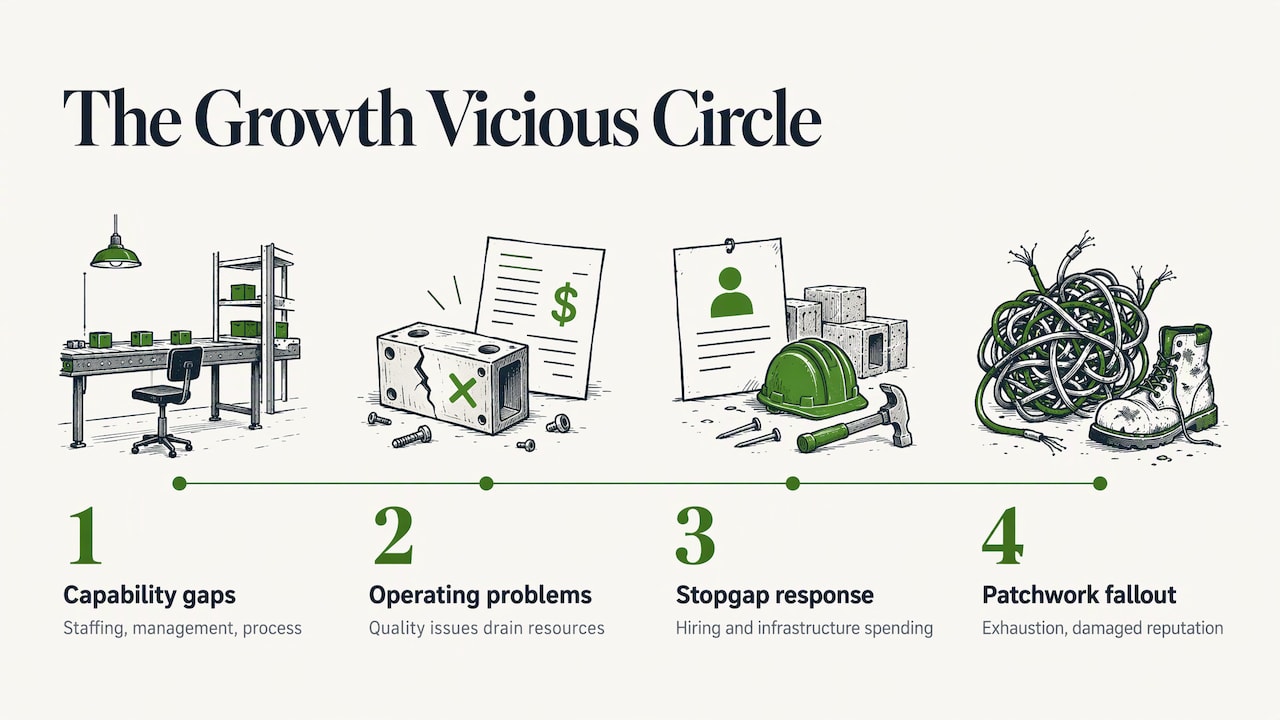
This is the pattern we see described again and again in growth stories: the response to strain is to add more of everything, which adds more complexity on top of a process that was already struggling.
Cash that cannot keep up with growth
Growth consumes cash before it produces it. You pay for inventory, payroll and onboarding now and collect from customers later. SCORE, the nonprofit mentoring network backed by the U.S. Small Business Administration, warns in its financial management workbook that rapid expansion often demands more upfront cash than a business has available. The same workbook recommends setting credit policies, handling late-paying clients and using electronic payments to bring cash in faster.
The SBA’s guidance on managing a business suggests starting financial management with a balance sheet, a snapshot of assets, liabilities and equity, and using cost-benefit analysis to weigh recurring benefits against costs before decisions such as hiring. It also notes that cash-basis accounting shows cash flow clearly but has limited predictive value, which matters when you are planning for volume you do not yet have.
A simple worked example shows why. Say a services firm wins a contract that needs three new hires. Payroll starts in week one. The customer is invoiced at the end of month one and pays on 45-day terms. The firm funds about two and a half months of the new payroll from its own account before the first dollar arrives. Multiply that across several contracts and a profitable company can run short of cash. Our article on improving cash flow by fixing the process first covers the invoicing and collection steps that shorten that gap.
When a funding gap is real, it helps to know the options before you need them. A marketplace that matches businesses with lenders offers working capital, lines of credit and SBA loans, and it is worth reviewing early, since lenders look at your records and forecasts and not at your plans.

Disconnected tools and fragmented data
A Forbes Business Council panel of 19 executives lists scaling challenges including growing too quickly without systems, strained culture, declining quality and consistency, and data fragmented across disconnected tools. Each tool made sense when it was bought. Together, they mean sales, finance and operations each hold a different version of the truth, and someone retypes data between them.
The usual instinct is to buy another platform to “integrate” everything. Often the better first move is to list what you already pay for, what each tool is used for, and which overlap. Our guide to application rationalization shows how to do that inventory.
The founder as the bottleneck
The same Forbes panel notes that founders get stuck doing $10 tasks instead of making $10,000 decisions. When every approval, exception and customer escalation routes through the owner, the business is capped by the owner’s hours. SCORE’s growth workbook says that as a business grows, it becomes increasingly necessary to organize, systematize and delegate with a solid management team. It recommends an operations manual detailed enough that key employees could run the business without the owner.
People and onboarding
Hiring fast without a repeatable process produces inconsistent results. If you have no HR department, even basic screening can swallow a founder’s week. One example is an AI-driven interview process built for founders, which shows how some teams ease the load. Whatever method you pick, write the hiring steps down first, because a tool can only speed up a process that exists. For the customer side, the same logic applies: our guide to the customer onboarding process covers steps, metrics and automation.
For restaurants and similar high-volume businesses, the equivalent risk is losing repeat customers as volume grows. A look at restaurant customer retention shows how consistency of experience, not new acquisition, often decides whether growth holds.
A quick diagnostic: where is your business breaking?
Before you plan anything, check which of these describe you. Each one points to a different repair.
Symptom | Likely cause | First thing to examine |
|---|---|---|
Revenue is up, profit is flat | Costs rising in step with sales | Cost per order, per customer or per project |
Cash is tight in a good month | Collection slower than spending | Invoice timing and payment terms |
Quality varies by who does the job | Undocumented process | The three most repeated tasks |
Staff retype the same data | Disconnected tools | Where information is handed off |
Owner approves everything | No delegation rules | Decisions that repeat weekly |
New hires are slow to contribute | No onboarding standard | First 30 days of a new role |
The pattern is that the symptom is almost never “we need more technology.” It is a gap in how work flows. If your costs are the main concern, our list of cost reduction strategies that start with operations is a good next read.
A sequence that avoids adding complexity
The order matters more than any single tactic. This is the sequence we recommend to small and mid-sized businesses.
Map how money moves. Trace a sale from first contact to cash in the bank. Note each handoff, who does it, how long it takes and what it costs. Lost revenue usually hides in the handoffs: a lead that nobody follows up, a quote that sits for a week, an invoice sent late.
Find the constraint. Every process has one step that limits the whole. Fix that step before improving anything else, because improvements elsewhere just build a queue in front of it.
Standardize what repeats. Write down the steps for the work done weekly or daily. Keep each document short enough that people use it. Our overview of operational performance improvement explains how to choose which processes to document first.
Decide who decides. Set clear rules for approvals and exceptions so the owner stops being the default answer. Our guide to operating model design covers roles, decision rights and the rhythm of management.
Automate the stable steps. Automation works on processes that are already clear. Automating a confusing process makes the confusion faster.
Protect cash and margin. Build a forecast that covers the extra payroll and inventory growth requires, and review it on a schedule. SCORE’s workbook suggests tracking measures such as the current ratio, quick ratio, debt-to-equity and net profit margin against industry benchmarks.
Add capacity last. Hire, open locations or add product lines once demand is proven and the process can absorb them.
Why an independent view helps
Most owners are too close to their own operation to see where it leaks. Vendors have a clear interest: a software company will find a software answer, an agency will find a marketing answer. An independent review has no such pull.
That is the idea behind how we work. Raremind does not sell software and takes no vendor commissions, so our advice is not tied to any product. We start by analyzing how your business makes money and where it loses it, using our proprietary Money Map to pinpoint lost revenue, excessive costs and process inefficiencies. If you want more context on this kind of engagement, read our overview of business transformation consulting.
Our perspective
Owners tell us they have a technology problem. When we map the business, it is almost always an operations problem that technology was bought to cover.
The pattern is consistent: a company grows, something strains, and the reflex is to buy a tool. Six months later there is one more subscription, one more login and the same strain. We think the right order is to understand how the business earns its money, find where revenue is lost or costs pile up, and only then decide what, if anything, to automate.
That is why we built the Money Map and why we sell no software and take no vendor commissions. Our advice has to be right for your business, not good for a product. Scaling should make your company more profitable without turning you into a technology company.
Mirko
How Raremind supports a scaling business
Your Digital & AI Office is our subscription retainer for ongoing strategic support: €995 per month, flat. It covers mapping your current workflows with the Money Map, finding revenue leaks and excess costs, advising on automation and digital and AI strategy, and assessing vendor and tool consolidation. Larger, hands-on initiatives are scoped separately as fixed-fee projects.

If you recognize the symptoms above and want an independent view before you spend on people or tools, you can see how the service works at Raremind.
FAQ
What does it mean to scale a business?
Scaling means revenue grows faster than the resources needed to produce it, so each additional sale costs less effort and money than the one before. Growing is adding revenue and resources at roughly the same pace. Most businesses grow first and scale once their processes can absorb the extra volume.
What are the most common problems when scaling?
The recurring ones are undocumented processes, cash strain from paying for growth before customers pay, disconnected tools, and an owner who approves everything. In the 2026 Inc. 5000 CEO Survey, 51% cited balancing strategic planning with daily operations and 48% cited standardizing processes as challenges.
How do I know if my business is ready to scale?
Check whether the business could handle a noticeable jump in orders without errors, late deliveries or you stepping in. If the core processes are written down, cash is forecast and decisions do not all route through you, you are closer to ready. If not, fix those first.
What is the difference between a startup and a scale-up?
A startup is still searching for a repeatable way to earn money. A scale-up has found one and is working to expand it, which shifts the challenge from finding customers to building systems, management and cash capacity that hold up as volume increases.
Should I buy new software to solve scaling problems?
Start by mapping where work and revenue break down. Often the answer is a clearer process or consolidating tools you already pay for. Automation then speeds up a process that works, instead of hiding one that does not.
Sources
Clarifying the scaling concept: A review, definition, and research agenda
How Fast Should Your Company Really Grow? (Harvard Business Review)
19 Common Challenges Businesses Face When Trying To Scale (Forbes Business Council)