
Digital Transformation Challenges: What Actually Stalls Projects
Most digital transformation challenges are not technology problems. They are problems of cost, skills, data, ownership and unclear priorities, and they show up when a business buys tools before it knows where its money is made and lost. If you run a small or midsize company, the way through is to start with revenue and operations, fix the biggest gap first, and only then choose technology. We built our consulting practice around that order, and the rest of this article explains why it works.
Raremindraremind.coFix the Gaps Before Choosing ToolsRaremind’s Money Map identifies lost revenue, excessive costs, and process inefficiencies, helping you focus digital transformation on business needs.Visit
TL;DR
The most common challenges for U.S. businesses are cost, a digital-skills gap, security and privacy, legacy-system integration, poor data, and unclear strategy or weak leadership support.
Many projects stall because the tool was chosen before the business problem was defined, not because the tool was bad.
A challenge is a condition you plan for (budget, skills, old systems). An execution failure is a decision or habit that makes the project drift (no owner, no measure, no sequence).
Measure success in revenue, costs and sustainability, not in how many tools went live.
Starting from how the business makes money, then deciding what to automate, avoids most of the expensive mistakes.
Table of Contents
The challenges that come up most often
Challenge by challenge: what it looks like in a small business
Challenge or execution failure? How to tell the difference
Why technology-first projects stall
A sequence that avoids most of these problems
What to measure
Where outside help changes the odds
Perspective: the order matters more than the tool
How we work with businesses facing these challenges
Sources
The challenges that come up most often
Research from different angles lands on a similar list. The National Center for the Middle Market found that cost was the most significant obstacle to digital transformation, and that a digital-skills gap affected nearly two-thirds of middle-market companies. The same report lists cybersecurity and privacy, legacy-system integration, poor or inaccessible data, unclear strategy, insufficient executive support, weak governance, siloed work, employee resistance, and difficulty selecting technology that solves a meaningful business problem.
A 2026 academic review in the Journal of the Knowledge Economy names cultural resistance, organizational inertia, skills shortages, weak leadership and vision, legacy-system integration, data quality, security and governance as recurring barriers. Different samples, same pattern.
For smaller companies the order shifts a little. A 2024 study of U.S. small and midsize businesses found that data privacy and security ranked as the dominant technology challenge, followed by figuring out which solutions fit, integration issues and lack of budget. The Small Business Majority reported that nearly all small businesses use at least some digital technology, while affordability and limited time and capacity get in the way of going further.
That last point matters. The question for a business with 15 or 80 employees is rarely whether to use technology. It is which change deserves the limited money and attention you have.

Challenge by challenge: what it looks like in a small business
A list of eleven obstacles is easy to nod at and hard to act on. Here is how the main ones appear in a company that does not have an IT department.
Cost and limited budget
Cost is the most cited obstacle, but the expensive part is often not the software license. It is the second and third tool bought to patch the gaps of the first, the consultant hours spent reconfiguring, and the staff time lost while people learn something they did not ask for. A project with a clear link to revenue or a cost line justifies its budget. A project described as “modernizing” does not.
The NFIB’s 2025 survey of U.S. small businesses shows the budget concern clearly. Among owners who had not introduced new or significantly improved technology, 20% said the technology was too expensive. If you are weighing smaller levers first, our guide to cost reduction strategies for small businesses shows how operations changes often pay for later technology.
The skills gap
When nearly two-thirds of middle-market companies report a digital-skills gap, a small company is rarely better placed. You may have one person who is “good with computers” and who ends up as the accidental systems administrator. That is a risk to the business, and it is also why projects stall when that person is busy or leaves.
Building capacity does not have to mean hiring a full-time specialist. Practical guidance on tools small businesses need can help you decide what a small team can reasonably run itself, and a clear owner for each system removes most of the rest of the problem.
Legacy systems and integration
The old system that “still works” is the subject of a surprising number of stalled projects. NFIB found that among small businesses that had not upgraded, 19% said an earlier upgrade was still working. Sometimes that is a sound judgment. Often the old system is fine and the real cost sits in the manual re-entry between it and everything else. Our practical guide to legacy system modernization for small businesses walks through how to tell which case you are in.
Data that cannot be trusted
CIO’s analysis of why digital initiatives stall points to incomplete or inaccurate data, inconsistent formats and standards, restricted access, weak executive sponsorship and absent governance. In a small company this looks ordinary: customers in three spreadsheets, invoices that do not match orders, and a CRM nobody fully trusts. Automation applied to bad data produces bad results faster. A data integration strategy comes before most automation, not after.
Security and privacy
Security ranked first for U.S. SMBs in the 2024 buying-journey study cited above. Every new tool is another place where customer and financial data lives, another login, another vendor. Fewer, better-chosen tools shrink that surface. For a closer look at how outside IT specialists approach protecting data and choosing integrations, see this overview of AI integration services.
Unclear strategy and weak leadership support
This is the challenge that sits under most of the others. Harvard Business Review’s analysis of small and midsize companies argues that digital transformation is broader than adopting technology and requires connecting the initiative to the business model, operating model, people and strategy. In a company of your size, “leadership support” means the owner or general manager making time every week, not signing off once.
Employee resistance
People resist changes that make their day harder or that they do not understand. The 2026 academic review treats this as a condition for success: training, communication, leadership clarity and culture determine whether employees can adopt new ways of working. Involve the people who do the work in mapping it. They know where the time goes.
Challenge or execution failure? How to tell the difference
This distinction is the most useful one in the article, and most guides skip it. Both feel the same from the inside: the project is late, costs more than planned, and nobody is happy. The cause, and the fix, differ.
A challenge is a condition that existed before you started. You have a tight budget, a small team, an old accounting system, messy customer records. You cannot remove it by trying harder, but you can plan around it: sequence the work, buy less, clean the data first.
An execution failure is something you did or failed to do after you started. A Walden University dissertation based on interviews with 13 U.S. project managers identified eight failure themes: lack of preparation, ineffective change management, unrealistic expectations, poor collaboration, insufficient early transparency, underestimated time and requirements, poor stakeholder communication and inadequate user experience. Every item on that list is a choice, not a circumstance.
Here is a simple test you can run on your own project:
Question | If the answer is yes | Likely category |
|---|---|---|
Would this problem exist if we had never started the project? | The condition predates the project | Challenge |
Can we name one person who owns the outcome? | If no, nobody is steering | Execution failure |
Did we define what revenue, cost or time result we expect? | If no, you cannot tell if it worked | Execution failure |
Did we pick the tool before we mapped the process it supports? | The sequence was wrong | Execution failure |
Is the limit a fixed one, such as budget or headcount? | It constrains scope | Challenge |
Once you sort the items, the plan is clearer. Challenges become constraints you design around. Execution failures become fixes you make this week: an owner, a measure, a smaller first step.
Why technology-first projects stall
The typical sequence is familiar. A vendor demo looks impressive, a peer mentions a tool, or a competitor announces something with AI in the name. A purchase follows, then a rollout, and only later does anyone ask which problem it was meant to solve.
The NFIB data shows how split small business owners are on technology. Overall, 57% of small-business owners had introduced new or significantly improved technology in the prior two years, with adoption at 51% among firms with 1 to 9 employees and 75% among firms with 50 or more employees. Among those who had not, 25% said nothing available would meaningfully improve the business. Some of those owners are skeptics for good reason: they have seen tools that did not tie to revenue.
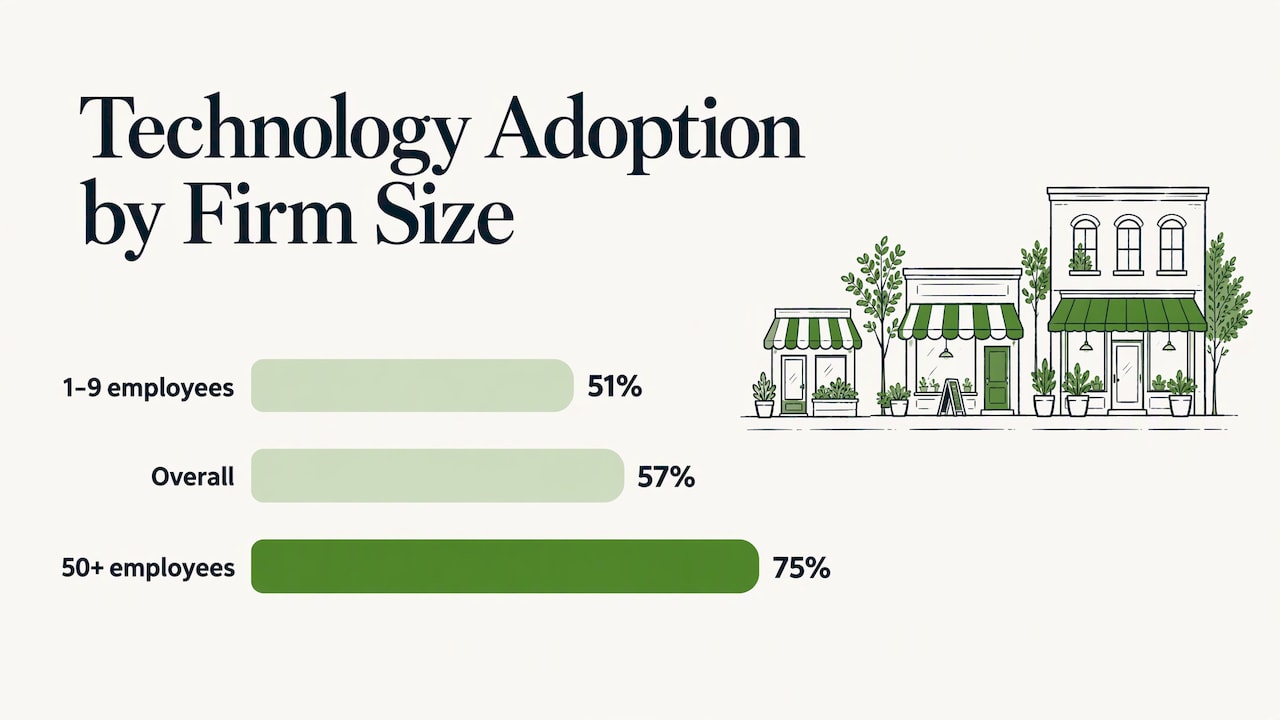
The lesson is not to avoid technology. It is that the benefit comes from the match between a tool and a specific gap in how you earn money or spend it. When you cannot name the gap, you are not ready to buy. Our AI readiness assessment guide shows how to map revenue workflows before choosing anything.
A sequence that avoids most of these problems
Whether you do this yourself or with a consultant, this order reduces the odds of a stalled project.
Map how the business makes money. Write down the path from first customer contact to cash collected. Mark every handoff, delay and manual step. This is where lost revenue and excess cost tend to sit.
Rank the gaps by money. Estimate what each gap costs in lost sales, rework hours or delayed payment. A gap worth a few hundred dollars a month does not get the first project.
Check what you already own. Many businesses pay for overlapping tools or features they never switched on. A technology assessment and application rationalization often free budget before any new purchase.
Fix the process, then automate it. Automating a broken process locks the problem in. Simplify the steps first.
Clean the data the automation will use. Settle on one source of truth for customers, products and prices.
Assign an owner and a measure. One person, one number, one review date.
Start small and expand. A first project that delivers in weeks builds the trust that the second one needs.
What to measure
A project with no measure cannot be called a success or a failure, and that is when discussions turn political. The 2026 academic review says leadership should assess transformation benefits through revenue, costs and sustainability, rather than treating technology implementation alone as evidence of value.
For a small business that translates into a handful of numbers set before the project starts:
Revenue: quote-to-close rate, repeat purchase rate, revenue per customer, time from order to invoice.
Costs: hours spent on manual re-entry, monthly software spend, error and rework costs.
Sustainability: whether the team still uses the change three and six months later, and whether one person leaving would break it.
Log the baseline before you change anything. Without it you only have opinions.
Where outside help changes the odds
Most small companies cannot spare someone to map operations, compare vendors and manage change at once. That is also where independent advice helps most, because a vendor’s consultant has a product to place, and your own team has a day job.
When the advice comes from someone who sells no software and takes no vendor commissions, the recommendation can be “fix this process and do not buy anything yet.” That recommendation is rare, and it is often the one that saves the most. For a wider look at how this kind of engagement works, read our overview of business transformation consulting.
Perspective: the order matters more than the tool
Most of the digital transformation challenges we see described come down to a single mistake in sequence. The business starts with technology and works backward to a problem. We start with how the business makes money and work forward.
That is why we built the Money Map. It lays out where revenue is generated, where it leaks, where costs pile up and where processes are inefficient. Once those gaps are visible, the technology question gets much smaller. Sometimes the answer is automation. Sometimes it is consolidating tools you already pay for. Sometimes it is a process change that costs nothing.
Because we do not sell software and take no commissions from vendors, we have no reason to push a tool. Our method is standardized, so you get a consistent approach, and our recommendations are customized to your business. The goal is not to turn you into a tech company. It is to improve profitability using the operations you already have.
Mirko
How we work with businesses facing these challenges
Our plan, Your Digital & AI Office, is a subscription retainer at €995 per month. It gives you ongoing strategic support: mapping your workflows with the Money Map, finding revenue leaks and excess costs, advising on automation and digital and AI strategy, and assessing vendor and tool consolidation. Larger, hands-on initiatives are scoped separately as fixed-fee projects.
If you recognize your own situation in the sections above, you can see how the engagement works at Raremind.

FAQ
What are the biggest challenges of digital transformation?
Cost, a shortage of digital skills, security and privacy, legacy-system integration and poor data come up most in U.S. research. Underneath them sit unclear strategy and weak leadership support. For small businesses, choosing which technology actually fits is a challenge of its own.
What is the biggest barrier to digital transformation?
Cost is the barrier most often reported in middle-market research, but projects usually stall for organizational reasons: no clear owner, no defined result, and tools chosen before the problem. Getting the sequence right removes much of the cost problem too.
How is a challenge different from an execution failure?
A challenge is a condition that existed before the project, such as a tight budget or an old system. An execution failure is a decision or omission during the project, such as no owner or no measure. You plan around challenges and correct execution failures.
How do I know digital transformation is working?
Compare revenue, costs and sustainability against a baseline you recorded before the project. Tools going live is not evidence of value. Fewer manual hours, faster order-to-cash and higher close rates are.
Sources
Digital Transformation in the Middle Market, National Center for the Middle Market
Where Digital Transformations Go Wrong in Small and Midsize Companies, Harvard Business Review, 2021
Reasons for Digital Transformation Project Failures, Walden University, 2026
AI Integration Services: What They Include and How to Choose