17 Cost Reduction Strategies for Small Businesses: Operations First
Small businesses can cut costs without blunt layoffs by fixing staffing and processes, auditing subscriptions, and tracking savings without hurting growth.

17 Cost Reduction Strategies for Small Businesses: Operations First
Cost reduction means lowering operating costs while maintaining or improving what your business delivers, not slashing budgets across the board. The sequence that works best starts with staffing and process changes, moves to subscription audits, then addresses office and energy spend, supplier terms, and marketing reallocation. This mirrors the targeted approach Harvard Business Review recommends over blunt, uniform cuts.
TL;DR:
Review open roles before cutting existing staff; delaying or redesigning a hire can reduce payroll without disrupting current employees or service.
Audit every active software license and assign a finance or operations owner; cancel unused seats before the next billing cycle.
When a vendor offers a 2% discount for payment within 10 days instead of 30, $50,000 in monthly spend yields $12,000 in annual savings.
Map a manual workflow and confirm its steps work before automating; keep human review for customer interactions, exceptions, and judgment calls.
Track realized savings against projections monthly, adjust for changes in volume or output, and check service quality so cuts do not erode results.
RaremindFind Costs Hidden in Your OperationsRaremind maps revenue gaps, excess costs and process inefficiencies, helping small businesses improve operations without pushing unnecessary technology.Explore Raremind
Table of Contents
1. Prioritized Strategies You Can Start Applying Today
2. Scoring Opportunities by Impact and Effort
3. Quick Wins Versus Deeper Projects
4. Measuring Savings Without Losing the Gains
5. Cuts That Backfire: What to Avoid
6. A Checklist to Work Through This Week
7. Mapping Where the Inefficiencies Actually Live
8. Automating Without Losing What Already Works
9. What Transformation Looks Like in Practice
10. Running the Numbers: Three Worked Examples
Why We Start With Revenue, Not Technology
Get a Clear Picture of Where Your Costs Actually Go
Sources
1. Prioritized Strategies You Can Start Applying Today
The strategies below are ranked by typical impact and effort, so you can tell at a glance what belongs on your near-term list versus later.
Restructure your next hire before cutting an existing role. Delay or redesign open positions, or fill non-core roles with nearshore or international talent. This is a quick win with no disruption to current staff.
Audit and cancel unused subscriptions. Most companies pay for software seats nobody opens. A review typically takes a day and produces savings the same billing cycle, making it a quick win.
Automate repetitive workflows. Invoice processing, scheduling, and data entry are common targets. This is a project: it needs mapping the current process before any tool decision.
Negotiate vendor contracts at renewal. Ask for volume discounts, longer terms, or price locks. A quick win if your renewal is already approaching.
Consolidate suppliers. Fewer vendors for the same category usually means better pricing and less administrative overhead. This is a project that takes a quarter to execute cleanly.
Implement spend controls or e-procurement approval limits. Gartner predicts that half of procurement contract-management tasks will be AI-enabled by 2027, a sign that procurement discipline is becoming table stakes, not a nice-to-have.
Shift to remote or hybrid work to shrink office footprint. The Bureau of Labor Statistics found that about one in three workers in management and professional occupations teleworked as of November 2023, which shows the model is well established, not experimental.
Run an energy and space audit. LED retrofits and smart thermostats are quick wins; renegotiating or downsizing a lease is a longer project tied to lease-end dates.
Optimize inventory levels. Carrying too much stock ties up cash; carrying too little costs sales. Review turnover by SKU before any ordering policy change.
Lease instead of buying equipment with fast depreciation. This protects cash flow on items like vehicles or computers that lose value quickly.
Cross-train staff across adjacent roles. This reduces the need for temporary hires during absences or demand spikes, a medium-effort project with lasting payoff.
Outsource non-core activities. Bookkeeping, IT support, and payroll processing are common candidates when the in-house cost of maintaining expertise outweighs the benefit.
Reallocate marketing budget to higher-ROI channels. Pull spend from underperforming campaigns and redirect it rather than cutting the budget outright.
Improve payment collection and offer early-payment discounts. Faster collections reduce the need for short-term borrowing, and a small discount can still beat the cost of carrying receivables.
Invest in retention to reduce costly turnover. SHRM documents how expensive replacing an employee can be, which makes retention a cost lever, not just an HR concern.
Apply data-driven prioritization methods. Pareto analysis, zero-based budgeting, and value stream mapping each help identify which 20% of costs or processes drive 80% of the waste.
Deepen customer retention efforts. Keeping an existing customer typically costs less than acquiring a new one, so retention campaigns often outperform acquisition spend per dollar invested.
Quick wins: subscription audits, thermostat and lighting changes, early-pay discount requests, canceling non-performing ads.
Longer projects: workflow automation, supplier consolidation, lease renegotiation, workforce redesign.
2. Scoring Opportunities by Impact and Effort
Not every lever deserves the same attention in the same quarter. A simple scoring rubric helps you rank candidates before committing resources: estimate potential annual savings, time to realize them, risk to revenue, and how easily the change can be reversed if it backfires.
Next hire restructuring: high savings, fast to realize, low revenue risk, easily reversible. Score it first.
Subscription audit: moderate savings, very fast to realize, near-zero revenue risk, fully reversible. Score it second.
Supplier consolidation: potentially high savings, slow to realize, moderate risk if service quality drops, harder to reverse once contracts are signed.
Staffing and process levers usually land in the highest-impact quadrant for service-based small and midsize businesses, since labor and software are often the largest controllable costs. Office and energy savings tend to be smaller in dollar terms but carry almost no downside, which makes them easy to schedule early.
Pro Tip: Build your initial plan around a few moves: restructure the next hire, finish a full subscription audit, then tackle an office or energy fix. Anything beyond that competes for the same attention and can slow progress.
3. Quick Wins Versus Deeper Projects
Subscription audit: finance or operations lead reviews every active license this week; savings show up on the next invoice.
Cancel unused seats: direct managers flag inactive accounts; takes a day, saves immediately.
Thermostat and lighting adjustments: facilities or office manager implements within a week; savings appear on the next utility bill.
Early-pay discount requests: accounts payable asks at the next invoice cycle; savings realized within 30 to 60 days.
Small vendor renegotiations: whoever owns the relationship raises it at renewal; realized at the next contract term.
Stop non-performing ads: marketing lead pauses campaigns this week based on existing data.
Workflow automation: operations or a designated project owner scopes it before any tool purchase.
Workforce redesign: leadership plans around hiring timelines and training.
Supplier consolidation: procurement or finance negotiates carefully to avoid service disruption.
Lease renegotiation: timing depends on lease-end dates.
Cross-training programs: HR or team leads build a curriculum around operational needs.
Retention investment: leadership and HR design and budget around the organization’s planning process.
Quick wins need a single owner. Deeper projects need sponsorship, a budget line, and a defined review date.
4. Measuring Savings Without Losing the Gains
Savings that aren’t tracked can drift back over time. A short set of KPIs keeps leadership honest about what’s actually working.
Operating-cost ratio: total operating costs divided by revenue, tracked monthly.
Subscription spend month-over-month: flags creeping renewals before they compound.
Realized versus projected savings: compares what you expected to what actually hit the P&L.
Vendor spend by category: shows where consolidation is paying off or stalling.
Headcount run rate: tracks whether staffing changes are holding.
A simple formula covers most cases: realized savings equal baseline cost minus actual cost, adjusted for any change in volume or output. Review the P&L regularly and run subscription audits on a recurring schedule, with a named owner, usually finance, accountable for both numbers.
Monitoring matters because software costs alone are often avoidable: Gartner found organizations can cut software costs by roughly 30% using a consistent set of best practices, which only holds if someone keeps checking after the first review.
Pair every financial check with an operational one: confirm that output, response times, or customer satisfaction haven’t slipped as a result of the change.
5. Cuts That Backfire: What to Avoid
Layoffs look like the fastest lever, but they carry severance costs, rehiring expenses once demand returns, and the loss of institutional knowledge that’s expensive to rebuild. Harvard Business Review’s guidance on cost cutting that makes you stronger treats workforce reductions as a last resort rather than a first move, favoring cuts tied directly to outcomes.
Invisible costs do more damage than people expect: duplicated software licenses across departments, unmanaged outsourcing overhead, or outdated contracts nobody has revisited in years. Finding them takes a mix of spend data review and short interviews with the people actually using each tool or vendor.
Set approval thresholds for new spend above a defined amount.
Assign named ownership for every major cost category.
Schedule recurring subscription and vendor reviews.
Keep operating-cost metrics visible to the leadership team, not buried in a year-end report.
6. A Checklist to Work Through This Week
Start with the moves that need no new budget and no new hire.
Pull a full list of active software subscriptions and cancel anything that is unused.
Flag any open job requisition and ask whether it can be delayed, redesigned, or filled remotely.
Review recent vendor invoices for upcoming renewal dates and prep a renegotiation ask.
Check thermostat schedules and lighting against actual office hours.
Pause any ad campaign that hasn’t produced a tracked conversion in 30 days.
List every recurring expense over a set threshold and name one owner for each.
Set a date on the calendar, 30 days out, to review what changed and what didn’t.
None of these require new technology or outside help. They require someone sitting down with the actual numbers, which is often the step that gets skipped when teams jump straight to tool shopping.
7. Mapping Where the Inefficiencies Actually Live
Before touching a single budget line, trace how money moves through the business: where revenue comes in, where it leaks, and which processes consume time without adding value. A simple way to start is listing every recurring cost next to the outcome it produces. If the connection isn’t obvious, that line deserves a closer look.
Interview the people doing the work, not just the people managing the budget. Front-line staff usually know which steps are duplicated or which tool nobody actually needs, long before it shows up in a spreadsheet. Combine that with a spend report sorted by category, and most businesses find the same pattern: a handful of categories account for most of the controllable cost, which is the same logic behind Pareto analysis and zero-based budgeting.
Value stream mapping, tracing a process step by step from request to delivery, often reveals handoffs that exist out of habit rather than necessity. This mapping step matters more than the cuts themselves: cutting a cost tied to a process you don’t fully understand can create a new problem somewhere else.
8. Automating Without Losing What Already Works
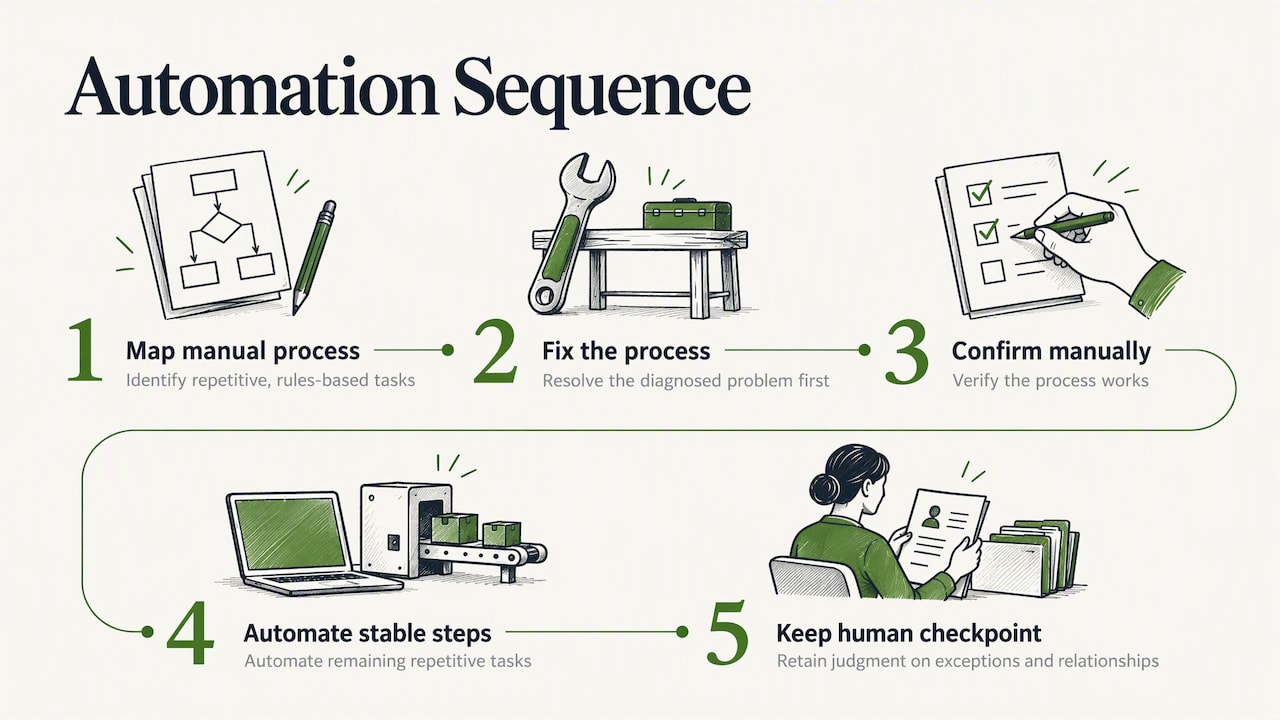
Automation earns its place when it removes a repetitive, well-defined task, not when it’s adopted because a competitor mentioned it. The businesses that benefit most start by mapping the manual process first, then automating only the steps that are genuinely repetitive and rules-based, like invoice matching or appointment reminders.
Over-reliance on new technology shows up in a familiar pattern: a tool gets purchased to solve a problem nobody fully diagnosed, and six months later it’s one more subscription nobody uses. A cautious sequence is to fix the process, confirm it works manually, and automate what’s left once the steps are stable.
Keep a human checkpoint on anything that touches customer relationships or judgment calls. Automation handles volume and repetition well; it handles exceptions and nuance poorly. A hybrid model, automating predictable tasks while keeping staff focused on work that needs judgment, can support profitability without turning a service business into a software company.
9. What Transformation Looks Like in Practice
A manufacturing business reviewing its spend might find that three overlapping project management tools are each used by a different department, none of them fully, with no one tracking the combined bill. Consolidating tools and renegotiating the license based on actual seat count may reduce that specific cost, depending on usage and vendor terms.
A services firm facing rising payroll costs might find that one role, originally hired for a narrow task, has quietly absorbed three unrelated responsibilities nobody re-evaluated. Redesigning that role, or splitting it across existing staff with spare capacity, frequently removes the need for a planned new hire altogether.
The common thread in both cases isn’t a new piece of software. It’s someone taking the time to trace spend back to the activity it funds, then making a targeted change instead of an across-the-board one. Selective automation, applied only after that mapping, tends to lock in the gain rather than create a new cost to manage later.
10. Running the Numbers: Three Worked Examples
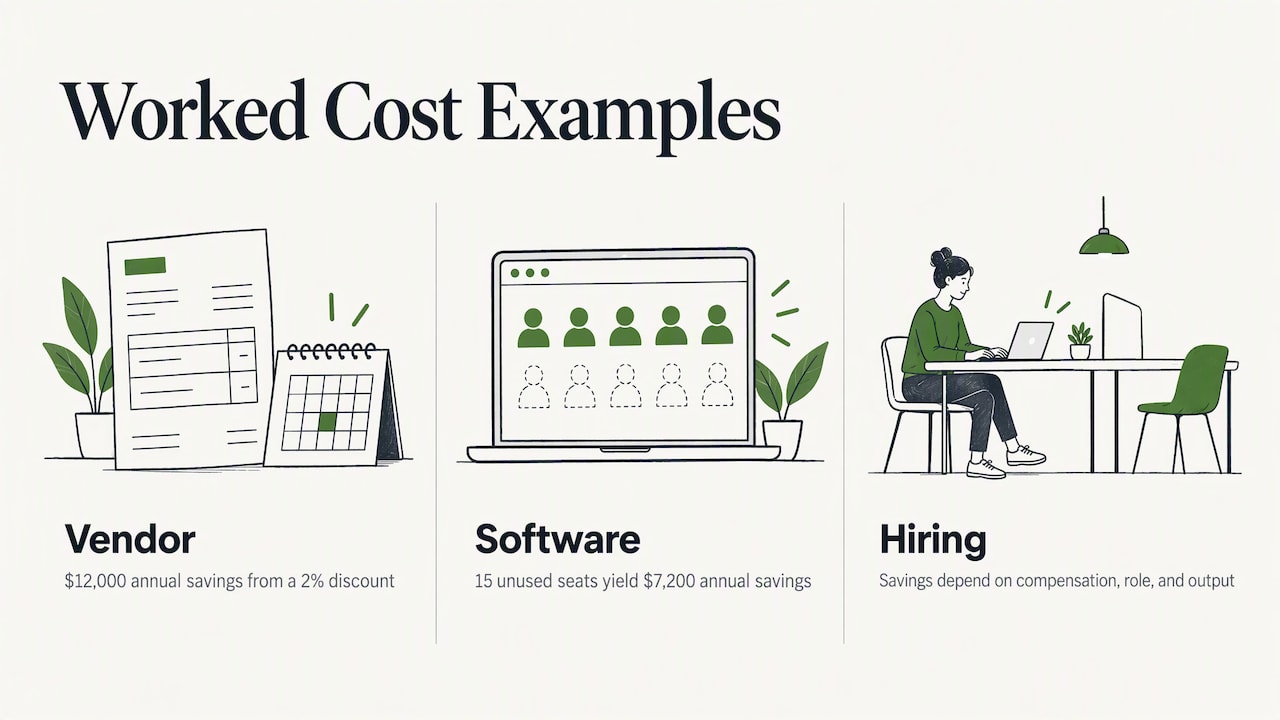
Say a vendor offers a 2% discount for payment within 10 days instead of the usual 30. On $50,000 in monthly vendor spend, that’s $1,000 saved every month, or $12,000 a year, just for paying faster.
Say a subscription audit finds 15 unused software seats at $40 per seat per month. That’s $600 a month, or $7,200 a year, recovered without touching a single active user.
Say a planned new hire is restructured into a part-time nearshore role for the same scope of work. The potential savings depend on compensation, the redesigned role, and whether it covers the same output.
These are illustrative examples, not universal benchmarks: your actual savings depend on your own spend, headcount, and vendor terms. The exercise matters more than the specific numbers: running this same calculation across your biggest cost categories usually surfaces two or three moves worth prioritizing immediately.
Why We Start With Revenue, Not Technology
Most cost reduction advice starts with a tool. We start by tracing how a business actually makes money and where that revenue leaks, using what we call a Money Map, before recommending a single piece of software.
That order matters because a tool bought to fix a process nobody has mapped usually becomes another cost to manage. We don’t sell software and don’t take vendor commissions, so a recommendation to automate, consolidate, or simply fix a process on paper carries no incentive beyond what actually works for the business in front of us.
Get a Clear Picture of Where Your Costs Actually Go
If the strategies above raised more questions than they answered, that’s normal: knowing which lever applies to your specific cost structure takes a closer look at your actual numbers, not a generic checklist.

We map how your business generates revenue and where costs and inefficiencies are hiding, using our Money Map process.
We recommend operational fixes first and bring in automation only where it genuinely pays off, with no software sales or vendor commissions involved.
Ongoing support runs through Your Digital & AI Office at €995 per month, with larger initiatives scoped separately as fixed-fee projects.
A short diagnostic call is the fastest way to find out which of these levers would move the needle most for your specific operation. Visit Raremind to get started.
FAQ
What are the methods of cost reduction?
Common methods include renegotiating vendor contracts, auditing subscriptions, automating repetitive workflows, restructuring staffing before layoffs, shifting to remote or hybrid work, and reallocating marketing spend to higher-performing channels. The strongest results come from sequencing these by impact and effort rather than applying them all at once.
What is strategic cost reduction?
Strategic cost reduction means cutting costs while protecting or improving output, connecting each cut to a specific outcome instead of applying an across-the-board percentage reduction. Harvard Business Review frames this as linking costs to results and simplifying processes rather than just shrinking budgets.
What are key role behaviors for cost reduction strategies?
Effective cost reduction depends on clear ownership: finance or operations leads should track savings monthly, department managers should flag unused resources in their own budgets, and leadership should set approval thresholds for new spend. Behaviors like regular subscription reviews and connecting every cut to a measurable outcome tend to separate lasting savings from temporary ones.
How much can software cost audits realistically save?
Software cost audits can meaningfully reduce spend: Gartner reports organizations can cut software costs by roughly 30% using a consistent set of best practices. The actual figure depends on how many unused licenses and overlapping tools a business is currently carrying.
Should remote work be part of a cost reduction plan?
Remote or hybrid work can meaningfully reduce office footprint costs, and it’s already a mainstream arrangement rather than an experiment. BLS data show about one in three workers in management and professional occupations teleworked as of November 2023.