AI Readiness Assessment: Map Revenue Workflows Before Buying Tools
Assess AI readiness across strategy, data, governance, talent, and culture before buying tools, then turn gaps into a prioritized roadmap for ROI.

AI Readiness Assessment: Map Revenue Workflows Before Buying Tools
If you are asking whether to run an AI readiness assessment, the answer is yes: it is the right next step for most leadership teams that want AI to produce measurable value rather than scattered pilots. Frameworks from NIST and the OECD both point to governance and workforce readiness as the real bottleneck, not the technology itself. Convene a short cross-functional scan, appoint an owner, and give the exercise enough time to gather evidence.
TL;DR:
Use six pillars: strategy, data, technology, governance, talent, and culture; require evidence such as inventories, policies, training logs, and sponsored experiments.
Assign one owner, interview leaders across business functions, score each pillar from 0 to 100 using evidence, and summarize gaps on one page.
Rank gaps by business impact and effort, but treat regulatory exposure as urgent even when its impact score is low.
Do not launch production use without a written governance approval path; first address data quality, draft policy, and run a safe pilot.
RaremindMap Revenue Before Choosing AI ToolsRaremind’s Money Map helps identify lost revenue, excessive costs, and process inefficiencies before you invest in technology.Explore Raremind’s approach
Table of Contents
What an AI readiness assessment actually measures
Running a short internal AI readiness assessment
Scoring the results and knowing what they mean
Turning gaps into a prioritized action plan
A compact AI readiness checklist you can use now
Why we start with revenue and process, not tools
How we help you turn an assessment into a prioritized roadmap
Sources
What an AI readiness assessment actually measures
A readiness assessment looks at several pillars, including strategy, data, technology and infrastructure, governance, talent, and culture. Each one needs concrete evidence, not an opinion from the executive team.
Strategy: a documented AI roadmap tied to business outcomes, with named owners and budget.
Data: a current data inventory, lineage documentation, and known quality gaps.
Technology and infrastructure: an inventory of model operations capability, integration points, and security controls.
Governance: written policies for risk review, approval, and monitoring, mapped loosely to the NIST AI RMF functions of govern, map, measure, and manage.
Talent: role-based training logs and a record of who can build, supervise, or audit a model.
Culture: examples of safe experimentation that leadership actually sponsored, not just permitted.
The OECD’s capability work is useful here too: it describes what a given AI system can realistically do, which keeps the strategy pillar honest instead of aspirational.
Running a short internal AI readiness assessment
A full assessment does not need months. A focused scan run by one owner, with input from relevant stakeholders, produces a usable picture.
Scope it. Name an executive sponsor and a single owner who will run interviews and compile findings.
Pick stakeholders. Talk to the sponsor, a data owner, someone from IT, legal or compliance, HR, and at least one business unit lead.
Collect evidence per pillar. Ask each stakeholder for documents, not impressions: strategy memos, data catalogs, policy drafts, training records.
Score each pillar. Use a simple 0 to 100 scale per pillar based on the evidence collected, not gut feel.
Assemble a one-page scorecard. Summarize scores, gaps, and the biggest risks in a single document the leadership team can review quickly.
Pro Tip: Ask managers to run one small, safe AI experiment during the assessment window and bring back a real example. A lived example moves adoption faster than a policy document ever does.
The World Economic Forum’s reporting on real-world adoption found that many organizations get stuck running pilots indefinitely instead of pushing toward production, which is exactly what a short, evidence-based scan is meant to prevent.
Scoring the results and knowing what they mean
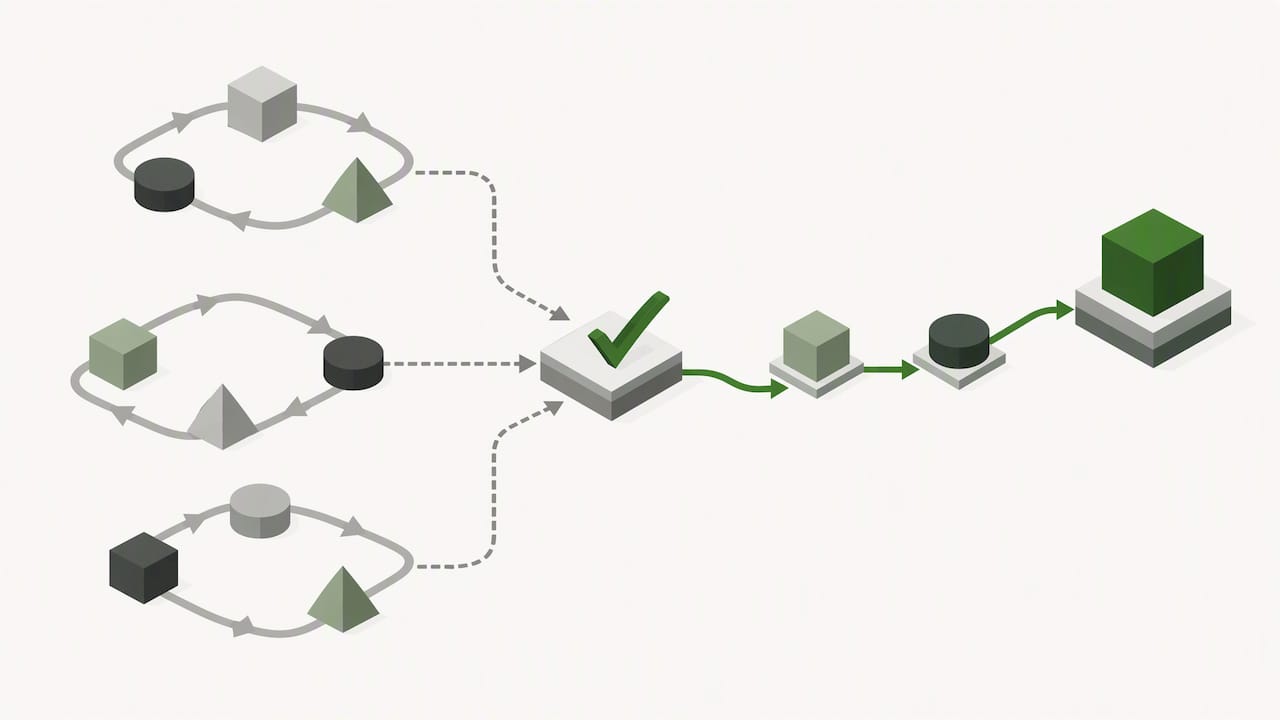
A simple rubric keeps interpretation consistent across pillars. Low scores signal that foundational gaps in data or governance may exist and that buying tools could be premature. Mid-range scores suggest limited or moderate readiness, where some pillars are solid and others need focused work. Higher scores may indicate readiness to scale specific use cases. The World Economic Forum describes a small share of organizations that distinguish themselves as “Pacesetters” through leadership, experimentation, and clear change plans.
Map each low-scoring pillar against business impact and effort to fix it.
Flag anything tied to regulatory exposure as urgent regardless of its impact score.
Group governance and risk fixes under the NIST functions of govern, map, measure, and manage so the work has a shared structure.
Turning gaps into a prioritized action plan
Once pillars are scored, rank the gaps by impact against effort, with a regulatory or risk overlay that can override the ranking when exposure is high. This is where an assessment stops being a report and starts being a plan.
Early phase: fix the most damaging data quality issue, draft a concise governance policy, and launch a safe pilot with a clear success metric.
Next phase: move the strongest pilot toward production, formalize role-based AI training, and close the biggest infrastructure gap identified in the scorecard.
Longer term: aim to have governance policies adopted, an AI-aware workforce, and a production use case tied to a measurable business outcome.
Tie every milestone to a number you can track, revenue recovered, hours saved, error rate reduced, so progress is visible rather than assumed. Our take on when AI makes business sense covers how to avoid chasing a tool before the underlying process justifies it.
A compact AI readiness checklist you can use now
Use this list in a working session with the stakeholders identified during the assessment. Each row is a quick yes or no with an evidence prompt attached.
Strategy: do you have an AI roadmap tied to a business outcome? Evidence: a signed strategy document.
Data: do you know where your core data lives and who owns it? Evidence: a data inventory with named owners.
Technology: can you deploy and monitor a model without manual intervention? Evidence: a documented operations process.
Governance: is there a written approval path for new AI use cases? Evidence: a policy document with sign-off.
Talent: can you name who is trained to build, supervise, or audit a model? Evidence: a training log.
Culture: has a manager run and shared a safe AI experiment? Evidence: a short write-up or demo.
A single “no” on governance, for example, is enough to delay any production rollout until a review policy exists, even if every other pillar scores well.
Why we start with revenue and process, not tools
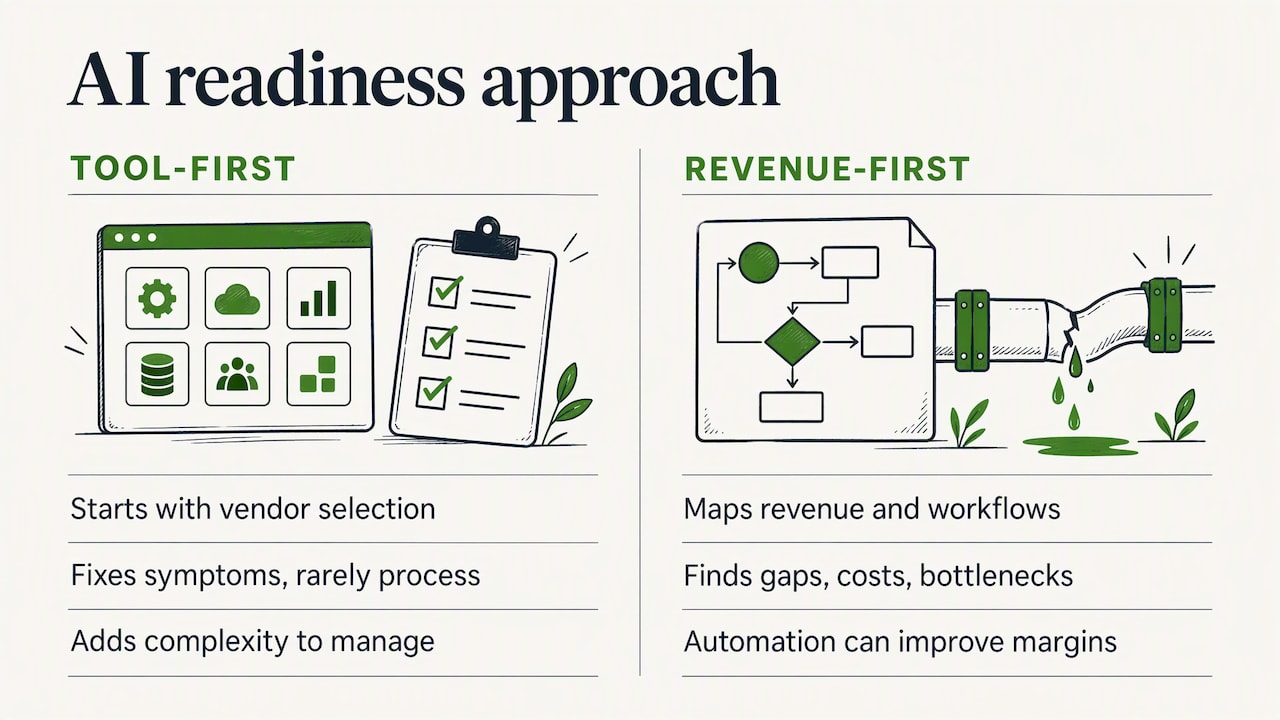
Most AI readiness conversations jump straight to vendor selection. We start somewhere else: how the business actually makes money and where that revenue leaks. Our Money Map traces current workflows to find the gaps, excess costs, and bottlenecks before any technology decision gets made.
That order matters. A tool bought to fix a symptom rarely fixes the underlying process, and it adds a new layer of complexity to manage. Working from revenue and workflow first tends to surface automation that improves margins instead of just shifting work around. Our view on strategic advisory versus traditional consulting goes deeper into why sequencing the diagnosis before the solution changes the outcome.
— Mirko
How we help you turn an assessment into a prioritized roadmap
If an internal scan surfaces more gaps than your team has time to prioritize, we run that process for you. Our Money Map approach maps how your business actually earns revenue, flags where process and technology are costing you margin, and builds a prioritized plan from there, with no software to sell and no vendor commissions clouding the recommendation.

The typical next step is a scoping conversation where we walk through your current operations and agree on what a full assessment should cover. The deliverable is a prioritized roadmap you can act on immediately, whether that means a focused engagement or an ongoing retainer through Your Digital & AI Office.
FAQ
What is the readiness assessment for AI?
An AI readiness assessment is a structured review of your strategy, data, technology, governance, talent, and culture to see whether your organization can adopt AI with measurable results. It produces a scorecard and a prioritized list of gaps rather than a single pass or fail verdict.
How do you measure AI readiness?
You measure it by collecting evidence for each pillar, documents like a strategy memo, a data inventory, governance policies, and training logs, then scoring each pillar on a consistent scale. The NIST AI RMF functions of govern, map, measure, and manage offer a useful structure for the governance and risk portion of that scoring.
How do you evaluate AI readiness?
Evaluation combines a short internal audit with input from an executive sponsor, data owners, IT, legal or compliance, HR, and business leads. Findings get compiled into a one-page scorecard that ranks gaps by business impact and effort to fix.
What is an AI ready test?
There is no single standardized “AI ready test,” but most assessment approaches use a scoring rubric similar to the one described by the World Economic Forum, where low scores indicate foundational gaps and high scores indicate readiness to scale. The goal is a repeatable way to compare pillars rather than a universal certification.
Can an outside consultant run this assessment instead of my internal team?
Yes, an independent consultant can run the assessment and is often faster because they are not tied to any particular vendor or tool. Look for an advisor who starts with your revenue and operations rather than a product pitch, since that sequencing tends to surface the gaps that actually affect profitability.