Revenue Operations Consulting: What It Covers and How to Choose
What revenue operations consulting includes, which metrics to track, what an engagement looks like, and how to pick an independent advisor for a small or mid-size business.

Revenue Operations Consulting: What It Covers and How to Choose
Revenue operations consulting is outside help in making sales, marketing, finance and customer success work as one revenue system instead of four separate ones. A good consultant maps how money actually moves through your business, finds where it leaks, and fixes the process, data and tools behind those leaks. For a small or mid-size business, the best engagements start with how you make money and only then touch technology.
This guide explains what a revenue operations consultant does, which metrics matter, what a typical engagement looks like, and what to ask before you hire anyone.
Raremindraremind.coFind Where Revenue Slips AwayRaremind’s Money Map identifies lost revenue, excessive costs, and process inefficiencies, starting with how your business generates revenue.Explore Raremind’s approach
TL;DR
Revenue operations (RevOps) treats the whole customer lifecycle, from first lead to renewal, as one system with shared data, processes and goals.
A consultant diagnoses the system first, then standardizes processes and data, then tunes forecasting and reporting. Tools come last.
Track a short list of metrics: funnel conversion by stage, win rate, sales cycle length, forecast accuracy, retention and cost to serve.
Choose an advisor who is independent of software vendors and starts from your revenue model, not from a platform.
We offer this as a flat monthly retainer, Your Digital & AI Office, at €995 per month.
Table of Contents
What revenue operations consulting actually is
What a revenue operations consultant does
Why forecasting and predictability are the real prize
Revenue operations metrics worth tracking
What an engagement looks like
Fixed project or monthly retainer?
How to choose a revenue operations consultant
Where we stand
Work with us on your revenue operations
Sources
What revenue operations consulting actually is
Forrester describes revenue operations as an iterative commercial execution strategy that unifies data, processes, technology and talent around the customer lifecycle. It also notes that RevOps is a capability that evolves with a company’s maturity, not a fixed organizational chart.
That definition matters for how you buy help. RevOps is not a one-time cleanup and not a software install. It is an ongoing discipline, and consulting is a way to get that discipline running without hiring a full department.
How it differs from general business consulting
General business consulting is broad: strategy, structure, pricing, hiring, markets. Revenue operations consulting is narrower and more operational. It asks one question across every department: where does revenue get created, delayed or lost between the first contact and the final invoice?
In practice that means looking at things a general consultant might skip:
How leads are handed from marketing to sales, and what gets dropped on the way.
Whether the quote, contract, invoice and payment steps agree with each other.
Whether customer success sees the same account data that sales promised during the deal.
Whether the numbers leadership uses to forecast are the same numbers in every system.
Why “revenue operations” and “revenue optimization” overlap
Readers search for revenue operations advisory, revenue optimization consulting and revenue optimization services as if they were different things. In practice, the work overlaps heavily. The label depends on the provider. Some lean toward sales and marketing alignment, others toward finance, pricing and cost. What you want to know is which parts of your revenue path the engagement will examine, and who does the hands-on work.
What a revenue operations consultant does
The job splits into four areas. A thorough engagement touches all of them, even if it starts with only one.
1. Align marketing, sales and customer success
When marketing attracts the wrong buyers, sales wastes time and customer success inherits accounts that churn. Professionals for Association Revenue notes that RevOps lets marketing target the right-fit customer, which in turn reduces churn and improves customer success outcomes. A consultant makes that concrete: shared definitions of a qualified lead, an agreed handoff, and one view of the account.
2. Fix the process before the tool
Most revenue leaks are process problems that software only hides. A quote that waits two days for approval, an onboarding step that depends on one person’s memory, a failed card that nobody follows up on. Fixing the sequence first means any later automation has something sound to automate. We cover the finance side of this in our guides on failed payment recovery and order to cash checks before automation.
3. Clean up data and the tool stack
Growing businesses collect tools faster than they retire them. The result is duplicate systems, disconnected platforms and numbers that disagree. A consultant audits what you pay for, what is used, what overlaps and what should be consolidated. If this is your situation, our guides on application rationalization and data integration strategy go deeper.
4. Build forecasting and reporting you can trust
Leaders cannot plan hiring, spending or cash without a believable forecast. Much of the value of RevOps shows up here, as the next sections show.
Why forecasting and predictability are the real prize
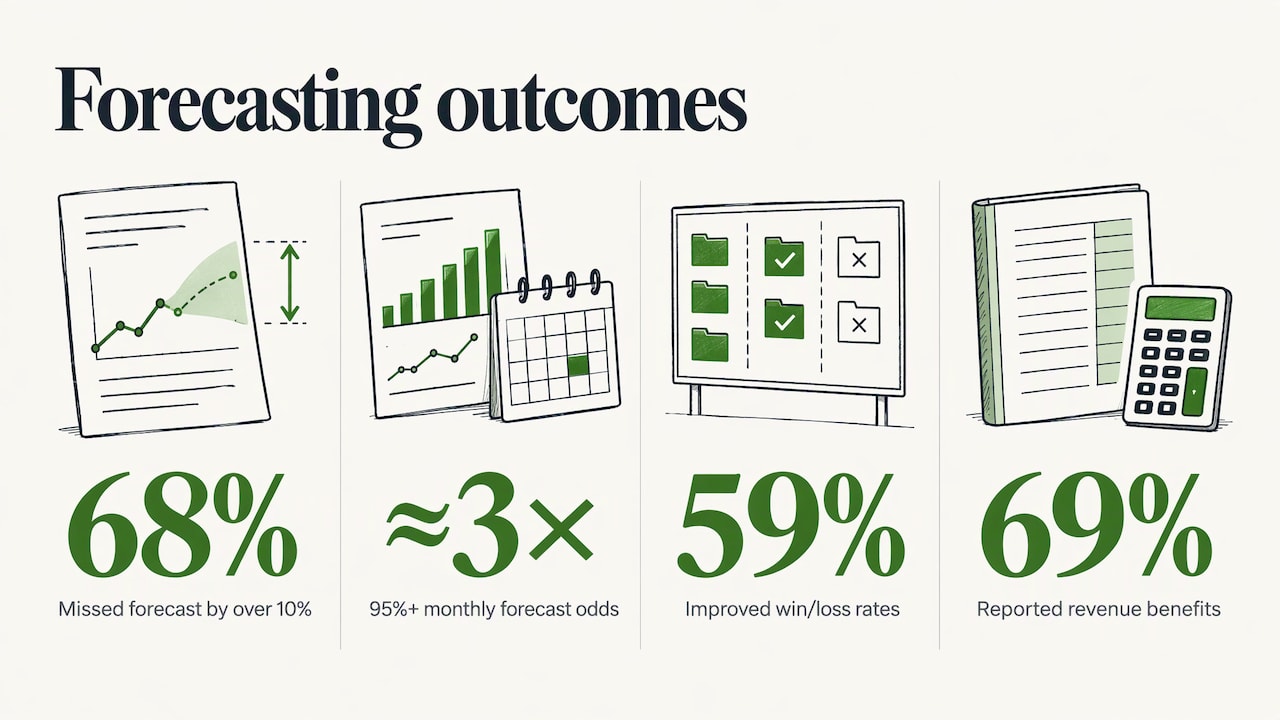
Forecasting is where weak revenue operations becomes visible. In InsightSquared and RevOps Squared’s 2021 survey, 68% of participants reported missing their forecast by more than 10%. A miss of that size is rarely a sales skill problem. It usually traces back to inconsistent stage definitions, stale CRM data and handoffs nobody owns.
Forrester’s 2021 study of U.S. software and technology decision-makers, commissioned by a revenue intelligence vendor, found that users of revenue operations and intelligence solutions were almost three times more likely to forecast with 95% or better accuracy monthly than those not using or piloting them. The same study reported that 59% saw improved win/loss rates and 69% saw revenue benefits overall. That study covers software and technology firms in the United States, so treat the figures as a direction, not a promise for your industry.
The same report argues that in volatile conditions, predictable revenue is what separates the strongest companies from the rest, because it lets leaders set expectations with boards, lenders and teams. For an owner-run business, the equivalent is simpler: knowing next quarter’s cash with fewer surprises.
Revenue operations metrics worth tracking
More dashboards do not mean more control. Start with a short list where every number has an owner and a single source of truth.
Metric | What it tells you | Typical question it answers |
|---|---|---|
Stage-to-stage conversion | How many leads or deals move to the next step | Where does the funnel leak most? |
Win rate | Share of opportunities that close | Are we chasing the right buyers? |
Sales cycle length | Days from first contact to signed deal | Where do deals stall? |
Forecast accuracy | Gap between forecast and actual revenue | Can we plan spending with confidence? |
Net and gross revenue retention | Revenue kept and expanded from existing customers | Are we keeping what we win? |
Failed or late payments | Revenue billed but not collected | How much is stuck between invoice and cash? |
Cost to serve | What each customer or segment costs to support | Which accounts look profitable but are not? |
The last two rows are where owner-led businesses often find money fastest, because they are rarely on a standard sales dashboard. Our guide to cost to serve analysis shows how to find the customers that cost you money.
Reading your funnel
The funnel metrics only help when each stage has one definition across teams. If marketing counts a lead at form fill and sales counts it at a first call, your conversion rates will never match reality. Fix the definitions first, then compare conversion at each step to your own history. Outside benchmarks are a rough guide at best, since they vary widely by industry, deal size and sales motion.
If your weak spot is the top of the funnel, how clearly your website explains what you do and how easily buyers can find you matters as much as the sales process. An AI search visibility audit can show whether answer engines and local search describe your business accurately before a lead ever reaches your pipeline.

What an engagement looks like
Every provider sequences the work a little differently, but a sound engagement moves through the same logic.
Diagnose. Map how the business makes money, step by step, from first contact to cash collected. Note every handoff, every manual step, every spreadsheet. We call our version the Money Map.
Quantify. Put a rough value on each gap: revenue not captured, cost not needed, time spent on rework.
Prioritize. Rank fixes by value and effort. Many of the first wins need no new software at all.
Standardize. Agree on definitions, ownership, and one source of truth for customer and revenue data.
Automate selectively. Automate steps that are already stable and high-volume. Add or retire tools only where the diagnosis supports it.
Measure and tune. Track the metrics above, review monthly, and adjust forecasting and reporting as the business changes.
The diagnostic step is the same idea as an operational audit, and our guide on how to run an operational audit walks through it in detail. If AI is on your mind, mapping revenue workflows before buying tools is the readiness step that most businesses skip.
How long it takes
Expect the diagnosis to take weeks, not days, and the improvements to compound over months. RevOps is described as iterative for a reason: forecasting and reporting get better only after process and data have been stable for a while. Be wary of anyone promising a finished revenue engine in a single sprint.
Fixed project or monthly retainer?
The right structure depends on the problem.
Fixed-fee project: fits a defined, hands-on initiative, such as consolidating a tool stack or redesigning an onboarding flow. The scope is agreed up front.
Monthly retainer: fits the ongoing reality of RevOps, where priorities shift as you grow and each fix reveals the next one.
Most small and mid-size businesses do not have enough work to justify a full-time RevOps hire, and a retainer gives them senior judgment on a predictable budget. We offer both: a monthly plan and separately scoped larger projects.
How to choose a revenue operations consultant
Treat the choice like hiring a finance advisor. Look for judgment and independence, not a slide deck.
Check where the advice starts
Ask what the first two weeks look like. If the answer begins with a platform, expect the recommendation to end with one. A diagnosis that begins with your revenue model, pricing, customers and handoffs is more likely to produce advice that fits.
Ask how the consultant is paid
Some advisors earn referral fees or resell software. That is not automatically wrong, but you should know about it. Independent advice means the consultant gains nothing from which tool you choose, including none at all.
Look for operators who talk about money
A strong advisor speaks in revenue recovered, costs removed and hours returned, not in tool features. Ask for a plain description of how they would measure success in your first quarter.
Match size to size
Enterprise RevOps programs assume dedicated teams and large budgets. A 20-person company needs a lighter approach that an owner or manager can actually keep up with. For cost-side wins, our small business cost reduction guide shows the operations-first order we recommend.
Where we stand
Most revenue problems we see are not technology problems. A business grows, adds a tool for each new pain, and ends up paying for overlapping systems that still do not agree on a single customer number. The instinct is to buy another platform.
We start somewhere else. Before anything about software, we map how your business makes money and where it leaks: lost revenue, avoidable cost, and processes that quietly waste hours. That is the Money Map, and it is a standard method applied to your specific business, so the recommendations are yours and not a template.
Because we sell no software and take no vendor commissions, the advice has no angle. Sometimes the answer is automation or AI. Sometimes it is removing a tool, fixing a handoff, or changing how you bill. Either way, you improve profitability without turning into a tech company.
That is why we offer this as an ongoing relationship: revenue operations is never finished, and an advisor who knows your numbers is worth more each month.
Mirko
Work with us on your revenue operations
Our plan, Your Digital & AI Office, is a flat monthly retainer at €995 per month. It gives owners and managers of small and mid-size businesses ongoing, independent advice on revenue leaks, cost, process and automation, built on the Money Map. Bigger, hands-on initiatives are scoped separately as larger projects.

If you want to know where your revenue is leaking before you spend on tools, start at raremind.co.
FAQ
What does a revenue operations consultant do?
A revenue operations consultant examines how leads become customers and customers become revenue, then fixes the process, data and tooling gaps along the way. Typical work includes aligning marketing, sales and customer success, standardizing definitions, auditing the tool stack and improving forecasting and reporting.
How much does revenue operations consulting cost?
Prices vary by provider and scope, so compare what is included rather than the headline number. Our own plan, Your Digital & AI Office, is €995 per month as a flat retainer, and larger projects are scoped separately with no published price.
Is revenue operations only for large software companies?
No. The research on forecasting often comes from software firms, but the underlying problems of handoffs, inconsistent data and unreliable forecasts show up in any business that sells repeatedly. Smaller companies simply need a lighter, owner-friendly version of the practice.
Do I need new software to start?
Usually not. The first gains typically come from clearer processes, agreed definitions and removing duplicate tools. Technology is added only where the diagnosis shows it will pay for itself.
Sources
Revenue Operations And Intelligence Delivers Predictable Revenue, Forrester and Clari (2021)
The State of Sales Forecasting Benchmark Research, InsightSquared and RevOps Squared (2021)